1-800-355-2335 |
Mon-Fri: 7:30am - 4pm EST |
Contact Us

FAQ
CAUTION: Always wear goggles when working with wire of any kind. The "whipping" action of a loose strand could take out your favorite eye. Pick up nails when working with wood fence. You will avoid stepping on it later and the lawn mower won't throw it into your neighbor's pet. Keep fingers out of pinch points when working around gates and you'll always be able to count to ten.
For simplicity we have broken down our FAQ sheet into several main categories.
Wood
If I have a 5-7 year old 6' wooden fence (in good condition) and thinking about relocating part of the fence--is it worth it to try to salvage the current post or just to purchase new ones?
We usually replace the posts because the price of new posts is not that much and we would not like the unsightly splices by 'scabbing' on an extended post. However there are times when adding an extension is more economical.
One such case would be, if the post is in a sidewalk or concrete pad. It is expensive to jack hammer the old post out and the concrete will never be the same. If a post must be extended, here are some ideas.
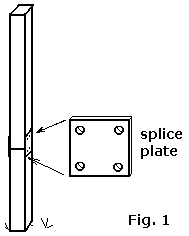
We use 1/4" thick x 4" x 4" galvanized steel plates that have holes predrilled in the corners (before galvanizing to avoid rust). Install two plates on opposite sides of the post, on sides that are least conspicuous, depending on the style of the fence. We prefer that these plates do not show anymore than necessary. We bolt the extension on with galvanized lag bolts. This splice will hold until 'the cows come home'. See Fig. 1.
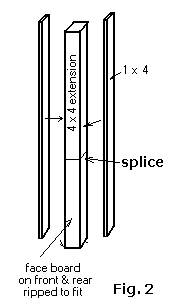
 Another method is to face the 4 x 4 post on four sides with your choice of wood. Use 1" x 6" ripped to fit around the post. A spacer/nailer 4 x 4 must be inserted as an extension to nail the face boards into. This method also gives a 'beefier' look to the post. It will measure 5" x 5", if you use 3/4" thick wood (actual size of a 1x6) as face boards. See Fig. 2 above.
We use these 'face' boards even on new construction to make posts bigger, or to face off a treated pine post with cedar to match the rest of the cedar fence. The top of the posts need capped with a 2 x 6 and finial to give the fence some style.
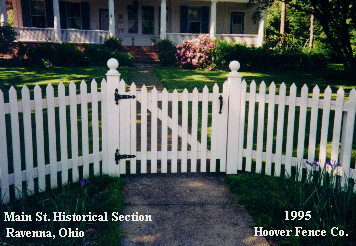
The photo shows a post 'faced' with cedar with a 1 x 6 cap and ball finial. The actual post is a 4 x 4" (actual size 3 1/2" x 3 1/2") with 1 x 6 red cedar face boards ripped to the proper widths. This gives a larger appearance post. If this had been an extended post, you would never know it.
One additional note: The fence sections attached to these gate posts actually curve 1/4 circle arch outward over two sections. How did we curve the rails uniformly? Perhaps I'll address that problem when presented with the question.
One such case would be, if the post is in a sidewalk or concrete pad. It is expensive to jack hammer the old post out and the concrete will never be the same. If a post must be extended, here are some ideas.
We use 1/4" thick x 4" x 4" galvanized steel plates that have holes predrilled in the corners (before galvanizing to avoid rust). Install two plates on opposite sides of the post, on sides that are least conspicuous, depending on the style of the fence. We prefer that these plates do not show anymore than necessary. We bolt the extension on with galvanized lag bolts. This splice will hold until 'the cows come home'. See Fig. 1.
We use these 'face' boards even on new construction to make posts bigger, or to face off a treated pine post with cedar to match the rest of the cedar fence. The top of the posts need capped with a 2 x 6 and finial to give the fence some style.
The photo shows a post 'faced' with cedar with a 1 x 6 cap and ball finial. The actual post is a 4 x 4" (actual size 3 1/2" x 3 1/2") with 1 x 6 red cedar face boards ripped to the proper widths. This gives a larger appearance post. If this had been an extended post, you would never know it.
One additional note: The fence sections attached to these gate posts actually curve 1/4 circle arch outward over two sections. How did we curve the rails uniformly? Perhaps I'll address that problem when presented with the question.
Do you ship wood fences?
Only in truck loads. Wood is heavy and shipping costs generally make us not competitive with most local markets. Of course you can only buy a Hoover fence from Hoover Fence, so many do pay the freight! 40' trailer loads are possible on wood split rail and paneled wood fences at competitive prices.
Are there standard sizes of wood gates and can you tell me anything about wood gates?
Please read the article below for valuable information concerning wood gates.
SUBJECT: WOOD GATES
This article was reproduced in World Fence News, May 1998.
The choice of wood gates presents some challenges that a person has to take into consideration. Although a good wood fence can be constructed that will last for 10-20 years without much more trouble than replacing an occasional warped picket or staining, the gate itself will be the first part of the fence to fail.
100% wood gates, with wood rails and wood diagonal bracing, are prone to sagging either within the frame itself or when the bolts in the hinges "pull" through the wood. This is due to the "soft nature" of fence wood, like red cedar. Although the cedar will be resilient to decay, it is very soft and bolts tend to "pull" through the wood eventually.
We take great care in constructing wood fences for this reason. All 2 x 4 framework is ship-lapped at joints and bolted with galvanized carriage bolts, two per corner or brace. It not only provides the maximum protection against sagging, but makes an attractive gate that looks finely crafted instead of one that just consists of 3 rails and a nailed on diagonal brace. On 5' to 7' high gates, we use 3 horizontal rails. On 4' high or less, we use 2 horizontal rails. Two vertical outside frame rails are used also that provide the outside rectangular frame. Each corner is routed so the intersecting rails lie flush to each other and we install two bolts at each corner. A diagonal 1 x 4 or some suitable other cedar matching piece is used as a diagonal brace to help delay sagging. This brace is also routed into the 2 x 4 frame to provide a clean, strong connection. It is also bolted with two bolts per connection. On a 3 rail gate, the diagonal gets routed and bolted to the center rail also.
In twenty years of making wood gates, this has been our most successful construction. The only other precaution is to use long bolts to secure the hinges to the posts or fence. Most hinge sets do not provide bolts long enough. The gate side bolts should pass through the picket and rails on the gate and be nutted. Lag bolts, which are usually provided with most hinge sets, will eventually pull out of the soft cedar or other wood that is used. Even in harder treated pine fences, the failure of bolts will occur eventually.
SUBJECT: WOOD GATES WITH STEEL FRAMES
The best gates use welded steel frames that have wood pickets attached to the frame. These gates will not sag like all wood framed gates. The frame resembles the wood counter part, but the diagonal is not needed with narrow gates. Since every style of fence is different the size, and layout of steel frames and bracing can vary a lot. The wider and taller the gate, the more diagonal bracing is required.
The cheaper steel frames consist of galvanized fence pipe notched at each weld for a neat, professional looking appearance. The pipe used is typically 2" OD. Wall thickness varies with gate use, style and size. This pipe frame is all galvanized and usually not painted to match the wood. Not as attractive as the more expensive version, but very strong and functional without spending a lot. The welds will burn off the factory galvanized finish, so a special galvanizing paint is applied after the welding to protect against rusting. The painted welds must be touched up in 3-5 years as the paint is not as good as the original galvanizing.
A nicer looking steel frame is one constructed of 2 x 3 or 2 x 4 steel stock to nearly match the appearance of the wooden rails on the rest of the fence. The steel is usually painted brown to keep with the appearance of the wood. it can be painted any color when ordered. These framed gates will cost a little more than the tubular type.
SUBJECT: AUTOMATION OF WOOD GATES
If you intend to install an automatic gate opener, you must take care in how the gate is constructed and carefully choosing the proper gate operator. All wood framed gates with automatic gate operators are not a good idea. The additional strain on the wood frame will cause more problems than normally associated with wood frames.
The welded steel framed gates are a better choice. The steel frame is strong enough to take the abuse of the operator. Most swing gates require a center brace regardless of the height. This provides a place for the operator arm to attach. It is wise to choose the operator with the gate. You can assure that proper bracing is installed in the gate ahead of time to accommodate the operator.
Wind is a major factor in wood gate and operator design. Heavier operators should be considered to handle the additional load on windy days. If the gate is hidden between buildings and foliage the problem is not as bad as a gate that is in a wide open space and has a constant wind. Consult with Hoover Fence gate operator experts to match gates to gate operators.
SUBJECT: WIDTHS OF WOOD GATES
Wood gates can be in any size within maximum limitations. Never make a wood gate wider than necessary. If a 3' wide walk gate is enough, forget the 1' waste on the rails and make it 3' (2 x 4's are usually 8' long). Every foot adds weight that will eventually make the gate more prone to sagging.
On widths of 6' or more, use a double swing gate. Gates of 16' opening size are the widest possible with wood frames. These gates should have a leading edge roller to help support the gate on each leaf.
Larger wood picket gates can be constructed, but steel frames are the only way to assure satisfactory results.
Here is some information to help you decide on width. Your front house door is no bigger than 36" so a minimum of 36" wide gates should be used. Your appliance will not fit through the gate that you want in the house.
A driveway should have 12' minimum clearance through the gate. 14' is better. That provides a single lane. Most highways are only 10' wide and people drive them at 65 miles per hour. A double lane driveway should then be at least 22' wide. 24' is better. Please don't drive that at 65 miles per hour though.
If your gate is near the road and trucks and trailers must get in, consider the turning radius. A 40' trailer requires a wide radius. You can generally see tire tracks off the driveway on existing drives. You better measure from the tire tracks and not the driveway. Someone will hit the gate post.
Consider setting the gate further from the road. A front fence could be right up to the road right of way, but angle the fence back on the sides of the driveway so you can allow for the gate to have a 15-20' set back. This not only provides a wider turning radius but allows a car to pull into the drive without having to stop in the road to open the gate. Don't make the gates any wider than necessary. It will only present problems.
SUBJECT: WOOD GATE SAFETY
Consider the weight of wood gates. They can get quite heavy. If small children have access to the gate and the latch and hinge side allow for pinch points, a child could get seriously hurt on a slamming gate. Put inside jams on the gate so little fingers will not get in the hinge side cracks when the gate is open. Leave ample space on the latch side so as not to allow little fingers to get caught in the small pinch points.
Keep in mind that on a windy day, the gate will create a sail that a small child can not open or close. Consider spaces between the pickets to allow for the wind to pass through. never let two children "play" with the gate. One will hurt the other when it is slammed on the unsuspecting victim.
SUBJECT: WOOD GATES
This article was reproduced in World Fence News, May 1998.
The choice of wood gates presents some challenges that a person has to take into consideration. Although a good wood fence can be constructed that will last for 10-20 years without much more trouble than replacing an occasional warped picket or staining, the gate itself will be the first part of the fence to fail.
100% wood gates, with wood rails and wood diagonal bracing, are prone to sagging either within the frame itself or when the bolts in the hinges "pull" through the wood. This is due to the "soft nature" of fence wood, like red cedar. Although the cedar will be resilient to decay, it is very soft and bolts tend to "pull" through the wood eventually.
We take great care in constructing wood fences for this reason. All 2 x 4 framework is ship-lapped at joints and bolted with galvanized carriage bolts, two per corner or brace. It not only provides the maximum protection against sagging, but makes an attractive gate that looks finely crafted instead of one that just consists of 3 rails and a nailed on diagonal brace. On 5' to 7' high gates, we use 3 horizontal rails. On 4' high or less, we use 2 horizontal rails. Two vertical outside frame rails are used also that provide the outside rectangular frame. Each corner is routed so the intersecting rails lie flush to each other and we install two bolts at each corner. A diagonal 1 x 4 or some suitable other cedar matching piece is used as a diagonal brace to help delay sagging. This brace is also routed into the 2 x 4 frame to provide a clean, strong connection. It is also bolted with two bolts per connection. On a 3 rail gate, the diagonal gets routed and bolted to the center rail also.
In twenty years of making wood gates, this has been our most successful construction. The only other precaution is to use long bolts to secure the hinges to the posts or fence. Most hinge sets do not provide bolts long enough. The gate side bolts should pass through the picket and rails on the gate and be nutted. Lag bolts, which are usually provided with most hinge sets, will eventually pull out of the soft cedar or other wood that is used. Even in harder treated pine fences, the failure of bolts will occur eventually.
SUBJECT: WOOD GATES WITH STEEL FRAMES
The best gates use welded steel frames that have wood pickets attached to the frame. These gates will not sag like all wood framed gates. The frame resembles the wood counter part, but the diagonal is not needed with narrow gates. Since every style of fence is different the size, and layout of steel frames and bracing can vary a lot. The wider and taller the gate, the more diagonal bracing is required.
The cheaper steel frames consist of galvanized fence pipe notched at each weld for a neat, professional looking appearance. The pipe used is typically 2" OD. Wall thickness varies with gate use, style and size. This pipe frame is all galvanized and usually not painted to match the wood. Not as attractive as the more expensive version, but very strong and functional without spending a lot. The welds will burn off the factory galvanized finish, so a special galvanizing paint is applied after the welding to protect against rusting. The painted welds must be touched up in 3-5 years as the paint is not as good as the original galvanizing.
A nicer looking steel frame is one constructed of 2 x 3 or 2 x 4 steel stock to nearly match the appearance of the wooden rails on the rest of the fence. The steel is usually painted brown to keep with the appearance of the wood. it can be painted any color when ordered. These framed gates will cost a little more than the tubular type.
SUBJECT: AUTOMATION OF WOOD GATES
If you intend to install an automatic gate opener, you must take care in how the gate is constructed and carefully choosing the proper gate operator. All wood framed gates with automatic gate operators are not a good idea. The additional strain on the wood frame will cause more problems than normally associated with wood frames.
The welded steel framed gates are a better choice. The steel frame is strong enough to take the abuse of the operator. Most swing gates require a center brace regardless of the height. This provides a place for the operator arm to attach. It is wise to choose the operator with the gate. You can assure that proper bracing is installed in the gate ahead of time to accommodate the operator.
Wind is a major factor in wood gate and operator design. Heavier operators should be considered to handle the additional load on windy days. If the gate is hidden between buildings and foliage the problem is not as bad as a gate that is in a wide open space and has a constant wind. Consult with Hoover Fence gate operator experts to match gates to gate operators.
SUBJECT: WIDTHS OF WOOD GATES
Wood gates can be in any size within maximum limitations. Never make a wood gate wider than necessary. If a 3' wide walk gate is enough, forget the 1' waste on the rails and make it 3' (2 x 4's are usually 8' long). Every foot adds weight that will eventually make the gate more prone to sagging.
On widths of 6' or more, use a double swing gate. Gates of 16' opening size are the widest possible with wood frames. These gates should have a leading edge roller to help support the gate on each leaf.
Larger wood picket gates can be constructed, but steel frames are the only way to assure satisfactory results.
Here is some information to help you decide on width. Your front house door is no bigger than 36" so a minimum of 36" wide gates should be used. Your appliance will not fit through the gate that you want in the house.
A driveway should have 12' minimum clearance through the gate. 14' is better. That provides a single lane. Most highways are only 10' wide and people drive them at 65 miles per hour. A double lane driveway should then be at least 22' wide. 24' is better. Please don't drive that at 65 miles per hour though.
If your gate is near the road and trucks and trailers must get in, consider the turning radius. A 40' trailer requires a wide radius. You can generally see tire tracks off the driveway on existing drives. You better measure from the tire tracks and not the driveway. Someone will hit the gate post.
Consider setting the gate further from the road. A front fence could be right up to the road right of way, but angle the fence back on the sides of the driveway so you can allow for the gate to have a 15-20' set back. This not only provides a wider turning radius but allows a car to pull into the drive without having to stop in the road to open the gate. Don't make the gates any wider than necessary. It will only present problems.
SUBJECT: WOOD GATE SAFETY
Consider the weight of wood gates. They can get quite heavy. If small children have access to the gate and the latch and hinge side allow for pinch points, a child could get seriously hurt on a slamming gate. Put inside jams on the gate so little fingers will not get in the hinge side cracks when the gate is open. Leave ample space on the latch side so as not to allow little fingers to get caught in the small pinch points.
Keep in mind that on a windy day, the gate will create a sail that a small child can not open or close. Consider spaces between the pickets to allow for the wind to pass through. never let two children "play" with the gate. One will hurt the other when it is slammed on the unsuspecting victim.
Are there any safety factors that must be considered when designing wood gates?
SUBJECT: WOOD GATE SAFETY
Consider the weight of wood gates. They can get quite heavy. If small children have access to the gate and the latch and hinge side allow for pinch points, a child could get seriously hurt on a slamming gate. Put inside jams on the gate so little fingers will not get in the hinge side cracks when the gate is open. Leave ample space on the latch side so as not to allow little fingers to get caught in the small pinch points.
Keep in mind that on a windy day, the gate will create a sail that a small child can not open or close. Consider spaces between the pickets to allow for the wind to pass through. never let two children "play" with the gate. One will hurt the other when it is slammed on the unsuspecting victim.
Consider the weight of wood gates. They can get quite heavy. If small children have access to the gate and the latch and hinge side allow for pinch points, a child could get seriously hurt on a slamming gate. Put inside jams on the gate so little fingers will not get in the hinge side cracks when the gate is open. Leave ample space on the latch side so as not to allow little fingers to get caught in the small pinch points.
Keep in mind that on a windy day, the gate will create a sail that a small child can not open or close. Consider spaces between the pickets to allow for the wind to pass through. never let two children "play" with the gate. One will hurt the other when it is slammed on the unsuspecting victim.
How do I pull out wooden posts (or any post)?
Question:
Can you Help....I want to replace an existing stockade fence, the post are 7 feet apart...I want to use the existing post holes...What would be the best way to remove the original post? They were installed with crushed stone about twenty years ago...90% of the stone is gone...Thanks... (name withheld by webmaster) P.S. nice home page...
Reply:
Thank you for the kind compliment.
Just pull the front loader up to the post and and yank them out with a chain! You don't have a front loader? Then try one of these ideas.
First of all, reusing 7' post spacing won't work on traditional sections of stockade fence, that are normally spaced 8' apart. Furthermore, many times the original installation may not have had perfect post spacing that would match a new fence. This fact and the fact that the old holes will probably be very odd shaped and huge, once the post is removed, makes it a losing situation, especially if you intend to pour concrete around the new posts. It is normally easier to cut the posts off below ground unless they pull out easier. Don't cut them off if a new post will have to go there though. It is a lot easier to pull the post out when it extends above the ground.
If you insist on removing the posts here are some ideas. Posts that are not set in concrete probably will pull out with a little persuasion. Wiggle the post back and forth as you lift it. That makes all the difference. Shake it back and forth violently and pull up. Repeat the process and the post will eventually lose the battle.
If you are grunting more than lifting, you need a little leverage. A lift stand is a steel tripod that has a ring at the top for a come-a-long to hook into. This will turn a 90 pound weakling into the fence post pulling champion of the world.
You may not want to make a lift stand for a few posts, so use a steel spud bar or heavy pipe as a leverage tool. Pipe works great. Stand up a 5-6' length next to the post. Place a board under it so it doesn't bury into the earth. Hook a come-a-long in the end of the pipe top. Wrap the bottom cable around the post a couple of times and hook it to itself. Crank the come-a-long tight. Now pull back on the pipe and watch that post move up. Don't crank your come-a-long too tight. The real action takes place when you 'lean' back on the pipe with your weight. Cranking hard on the come-a-long will only break or damage the tool. Remember to wiggle that post horizontally between tugs.
We remove hundreds of posts every year just this way. What is a come-a-long? We sell them on our tool page. By the way, I would "kill" an employee for wrapping the come-a-long around the post. It does tear up the cable eventually. We use cable slings instead, which is a 1/4" cable with loops at each end. They are easier to replace then come-a-long cables. You will remember this little tip after just one time grabbing at a frayed cable that sinks tiny wires up under your fingernails (hurts to think about it).
If you have a lot of posts, cut a hole in heavy plate steel that is just slightly bigger than the post. Make a hole on one end of the plate for a chain or come-a-long hook to grab onto. Slide the plate down over the post and when you lift it from the one side with the chain, it will bind up on the post and give a death grip that will not let go (it would break or bend the post first).
Note: If you would like to purchase a post puller, you can find them on our tool page. It's called the Post Popper.
A Guest at Hooverfence.com suggests a method for pulling posts
In your FAQs I noticed someone wanted to remove fence posts from the ground. I have used the following method with great results: Purchase an automobile bumper jack from a Auto junk yard, wrap a chain around the post and put a link of the chain on the tip of the jack that would fit in the hole in the bumper. Place a board on the ground to keep the jack from slipping into the ground as you jack. The post will slip right out of the ground. If your post is in concrete , I have used a heavy duty farm "bumper jack" to pull the post and concrete out of the ground. I used this type jack to completely remove and rebuild my fence when I lived in Texas....borrowed the farm jack from my neighbor who ran a small herd of cattle.
George Constande
Salisbury, NC 28147
Just pull the front loader up to the post and and yank them out with a chain! You don't have a front loader? Then try one of these ideas.
First of all, reusing 7' post spacing won't work on traditional sections of stockade fence, that are normally spaced 8' apart. Furthermore, many times the original installation may not have had perfect post spacing that would match a new fence. This fact and the fact that the old holes will probably be very odd shaped and huge, once the post is removed, makes it a losing situation, especially if you intend to pour concrete around the new posts. It is normally easier to cut the posts off below ground unless they pull out easier. Don't cut them off if a new post will have to go there though. It is a lot easier to pull the post out when it extends above the ground.
If you insist on removing the posts here are some ideas. Posts that are not set in concrete probably will pull out with a little persuasion. Wiggle the post back and forth as you lift it. That makes all the difference. Shake it back and forth violently and pull up. Repeat the process and the post will eventually lose the battle.
If you are grunting more than lifting, you need a little leverage. A lift stand is a steel tripod that has a ring at the top for a come-a-long to hook into. This will turn a 90 pound weakling into the fence post pulling champion of the world.
You may not want to make a lift stand for a few posts, so use a steel spud bar or heavy pipe as a leverage tool. Pipe works great. Stand up a 5-6' length next to the post. Place a board under it so it doesn't bury into the earth. Hook a come-a-long in the end of the pipe top. Wrap the bottom cable around the post a couple of times and hook it to itself. Crank the come-a-long tight. Now pull back on the pipe and watch that post move up. Don't crank your come-a-long too tight. The real action takes place when you 'lean' back on the pipe with your weight. Cranking hard on the come-a-long will only break or damage the tool. Remember to wiggle that post horizontally between tugs.
We remove hundreds of posts every year just this way. What is a come-a-long? We sell them on our tool page. By the way, I would "kill" an employee for wrapping the come-a-long around the post. It does tear up the cable eventually. We use cable slings instead, which is a 1/4" cable with loops at each end. They are easier to replace then come-a-long cables. You will remember this little tip after just one time grabbing at a frayed cable that sinks tiny wires up under your fingernails (hurts to think about it).
If you have a lot of posts, cut a hole in heavy plate steel that is just slightly bigger than the post. Make a hole on one end of the plate for a chain or come-a-long hook to grab onto. Slide the plate down over the post and when you lift it from the one side with the chain, it will bind up on the post and give a death grip that will not let go (it would break or bend the post first).
Note: If you would like to purchase a post puller, you can find them on our tool page. It's called the Post Popper.
A Guest at Hooverfence.com suggests a method for pulling posts
In your FAQs I noticed someone wanted to remove fence posts from the ground. I have used the following method with great results: Purchase an automobile bumper jack from a Auto junk yard, wrap a chain around the post and put a link of the chain on the tip of the jack that would fit in the hole in the bumper. Place a board on the ground to keep the jack from slipping into the ground as you jack. The post will slip right out of the ground. If your post is in concrete , I have used a heavy duty farm "bumper jack" to pull the post and concrete out of the ground. I used this type jack to completely remove and rebuild my fence when I lived in Texas....borrowed the farm jack from my neighbor who ran a small herd of cattle.
George Constande
Salisbury, NC 28147
I have recently purchased a home with a cedar (I believe) wood fence. The fence is approximately 6 years old and has turned gray in most areas. It's pressure treated wood and has a 25 yr warrantee, however, is it possible to regain the original brownish wood color and then use a clear stain or just use a brown stain on this? Would this help in reducing any potential future warping or extend the life of the fence?
Question:
I have recently purchased a home with a cedar (I believe) wood fence. The fence is approximately 6 years old and has turned gray in most areas. It's pressure treated wood and has a 25 yr warrantee, however, is it possible to regain the original brownish wood color and then use a clear stain or just use a brown stain on this? Would this help in reducing any potential future warping or extend the life of the fence?
Reply:
Unfortunately it may be too late. To retain any wood's coor, one must stain it right away. After even a year the wood will lose its color by moisture and fading in the sun. The one way to change the color is to stain or paint it. Many colors and shades are now available. Consult your local paint/ stain supplier for the proper paint or stain to use. They will also be able to recommend a brand as it is out of my specialty. Painting or staining does increase the life expectancy and decrease the likelihood of warping and cracking, however wood will do this regardless. You may wish to replace it with a low maintenance vinyl fence which doesn't have these problems. View our styles here:
Vinyl Fence
Does it matter if a cedar fence is touching the ground?
Yes, it does matter if a cedar fence is touching the ground. It will rot prematurely if it is installed this way. A 2" ground clearance is recommended between the fence and the ground. Additional information may be found here on cedar fence construction by reading about the various styles: Wood Fence
- Check out our ornamental post caps for wood fences: Post Caps.
- Check out our low maintenance alternative to sagging gates: Adjust-A-Gate Kits
Is it necessary to pour concrete around the fence posts?
It really depends on what type of fence it is, how long you wish it to last, what type of post(s) they are, and how tall and of what material the fence/ gate is made of. Typically yes, fences should have posts which are cemented in the ground. However cedar posts are an exception, temporary fences are typically not cemented, and many chain link fences are installed uncemented and with post flanges/ anchors which serve a similar purpose.
Updated 06/01/06
Updated 06/01/06
How many inches from the ground should the cross board be?
It depends what style of fence you are interested in. All the measurements and specifications are available online for our vinyl and ornamental aluminum fences. For other styles or the occasional style online which does not list its specifications, you may call our 800 number for its measurements. Typically fences are installed 2" off the ground, variances are not unusual and depend on the particular job application.
Updated 06/01/06
Updated 06/01/06
Should I let vines grow on a wood fence?
Yes, if the wood is not treated. The pressure treated type of lumber can stand it, but untreated wood will rot quicker. Vines on chain link fence will accelerate the rusting process as well. Never use treated wood around edible vegetables. The treatment can leach into the soil and cause possible contamination of the food.
Updated 06/01/06
Updated 06/01/06
Will a 4"x4" pressure treated post last longer than a 4"x4" white cedar post?
If cedar is cemented, it will rot. Also cedar has a tendency to rot quicker than treated wood when it touches the ground. Most wooden fences should be cemented with treated posts. For more information on cedar/ treated wood and installations of fences read more about the fence styles viewed here.
- Check out our ornamental post caps for wood fences: Post Caps.
- Check out our newly added cedar products: Adjust-A-Gate Kits
- Check out our low maintenance alternative to sagging gates: Furniture
What's a reasonable estimate on cost for materials and labor for a wood fence?
It is hard to estimate as you didn't give me a height and prices vary all over the country, both the material and the labor. Under $150 for the 6' high panels is reasonable and labor could be between $50-75 per panel. Posts are generally between $15-20. Concrete is extra and you would need 7 panels and 8 posts. I hope this helps some.
Updated 06/01/06
Updated 06/01/06
How do I mount a wood gate to brick?
Several methods will work for this job. Read the information below to figure which procedure will work best for you.
Easiest method
Use a slide bolt and drill a hole for the bolt to slide into the brick.
Slide Bolt Latch You can only open the gate from one side with this latch.
Purchase a type of latch that has a steel catch that can attach to a flush surface, sometimes called a column mount. See here.
You may have to purchase some sort of masonry anchor separately. Mount your hinges on a post.
Another latching method
Attach a small block of wood with masonry anchors to the brick. Attach your latch catch here. This method would be used for "surface mount" type latches.
Surface mount required
Harder method
If you must hinge off the brick, choose your hinges carefully. A strap hinge is not the best. T-hinges are better. If the gate only needs to swing one way, bend the shortest half of the T-hinge flat to the brick and secure with masonry anchors.
See T-hinge
See strap hinge
Another option is to bolt a 4 x 4 post to the brick and mount the hinges to the wood. Drill through the post 2 or three times and use a masonry anchor and lag bolt. If the short side of the T-hinge is under 1-1/2", you can bolt a 2 x 4 to the brick.
Use a flush-mount hinge. This allows you to mount the hinge to the flat brick surface. These hinges are hard to find. We do not carry them.
Grout a screw and eye type hinge into the brick. Since the threads are not needed on the brick side of the hinge, you can cut some of the long bolt off. Mount the bolt 3" into the brick. Quick-set, expansion cement is excellent for grout. This type of hinge will allow the gate to swing either direction but make sure you choose a latch that will also.
Updated 06/01/06
Easiest method
Use a slide bolt and drill a hole for the bolt to slide into the brick.
Slide Bolt Latch You can only open the gate from one side with this latch.
Purchase a type of latch that has a steel catch that can attach to a flush surface, sometimes called a column mount. See here.
You may have to purchase some sort of masonry anchor separately. Mount your hinges on a post.
Another latching method
Attach a small block of wood with masonry anchors to the brick. Attach your latch catch here. This method would be used for "surface mount" type latches.
Surface mount required
Harder method
If you must hinge off the brick, choose your hinges carefully. A strap hinge is not the best. T-hinges are better. If the gate only needs to swing one way, bend the shortest half of the T-hinge flat to the brick and secure with masonry anchors.
See T-hinge
See strap hinge
Another option is to bolt a 4 x 4 post to the brick and mount the hinges to the wood. Drill through the post 2 or three times and use a masonry anchor and lag bolt. If the short side of the T-hinge is under 1-1/2", you can bolt a 2 x 4 to the brick.
Use a flush-mount hinge. This allows you to mount the hinge to the flat brick surface. These hinges are hard to find. We do not carry them.
Grout a screw and eye type hinge into the brick. Since the threads are not needed on the brick side of the hinge, you can cut some of the long bolt off. Mount the bolt 3" into the brick. Quick-set, expansion cement is excellent for grout. This type of hinge will allow the gate to swing either direction but make sure you choose a latch that will also.
Updated 06/01/06
How do I install a wood fence on an existing masonry wall?
Question:
How do I install a wood fence on an existing masonary wall? I have a concrete barrier wall surrounding my property. An old fence, probably built in 1932 with the house was imbedded in the wall. It was a simple wire fence with round posts 12 feet apart. We need to install wood fence on this existing cement wall and will be extending it in one place where we can pour the brackets at the same time. What brackets (post anchors?) should we be looking for to use in the existing cement? We also will be needing the ones that we can pour in cement. I need to start with these parts but I don't know what to call them or where to find them. We can drill concrete no problem.
We feature all our products online complete with current pricing, specifications, and helpful how-to information. I understand that you wish to install wood fence on an existing masonry wall. We recommend using galvanized, tubular posts (the same type as used on chain link fences) for this application. Simply core drill into the wall and set posts accordingly using a fast setting cement, brands such as Quik-Rok work well. Use the steel to wood post adapters found in our wood fence hardware catalog to attach wood rails to posts. These brackets are found here: Fence Brackets. More wood hardware is found here: Gate Hardware.
Updated 06/01/06
Updated 06/01/06
How do I cut wood posts?
Question:
How do I cut wood posts? Thank you for putting so much helpful information on the Web. I do have a question I'm hoping you may help with. I am in the process of replacing a 6 foot stockade fence. I have tore the old sagging fence down. The back section was merely 8 foot landscape posts stuck 2 feet in the ground! The sides were ~6 inch round posts (tapered to a point at the top) set in concrete. I used a jack to remove those not in concrete, and also the corners in concrete, as I needed to use the corners. The remaining posts (in concrete) I cut off below ground level. I used 10 foot pressure-treated 4 x 4s and dug out the holes 36-42 inches deep 8 feet apart, set in quick set post concrete. So far, it looks great! The rails are very level and all that remains is trimming (i.e. building some rises were the ground clearance would be too great to fill, gates, etc.). My question is this: What is a good way to cut off the uneven post tops? And at what height? I have tried a couple of ways, 1- using circular saw and going around the post as the blade is on 8 inches and can not cut through on one pass... very uneven results, 2- used a speed square to try and get 2nd/3rd passes more even...limited success, 3- one pass with circular saw, finishing cut with reciprocal saw...best results so far. As I will probably use post caps on the fencing posts which are visible (the neighbor-side fencing), I guess the Hatteras slip-over caps are my best bet.? With the post caps, I imagine they should be cut at fence level or higher. Could you please confirm? Which of those that you carry do you recommend? The lady there who answered the phone suggested using finishing nails and/or shims to level. I am concerned with using finishing nails as they would rust. Thank you very much for any help you might provide.
Usually when constructing wood fences, care and consideration is taken prior to setting the posts in concrete so that they are set at the correct height to begin with, alleviating the need to cut any posts. However various circumstances may force you to cut posts off at the correct height after they are set in the ground. Some of the methods you mentioned are common methods to cutting off posts and with experience and skill it can be done perfectly. We have also used a chain saw to cut off posts with success. I do not know of a tool on the market to make this job easier. You may use any of our ornamental wood post caps found online here: Post Caps.. We also have an assortment of quality hardware for gates found in Gate Hardware. The choice of cap and the height to cut off posts is purely an aesthetic choice. Cut them at your preferred height and remember to consider the height of the post cap when doing so. You will most likely secure post caps to posts with finishing nails or an adhesive. Either method allows one to level the caps on uneven posts during installation. Use aluminum or stainless steel finishing nails to prevent rust. A few other notes: *Since stockade is usually the cheapest wood fence one can purchase, ornamental caps usually aren't used. Most privacy fences in wood won't have ornamental caps since most of the post is hidden behind the fence section. Ornamental caps or cuts in posts are more common in picket styles, especially those with fully exposed posts. *Most customers who use this fence usually aren't very concerned with rusting of fasteners since they installed the cheapest fence they could find to begin with. Chances are a stockade fence will have lived its life, warped, cracked, and generally deteriorated long before any fastener will rust. *As far as finishing nails rusting - all steel rusts, all wood warps and cracks, and all concrete footers fail. Of course, with proper choice of hardware and building methods, these things can be prevented for a time, however they will still occur. Galvanized, stainless, and/ or aluminum fasteners are items on the market to help prevent such deterioration. If you are concerned about rust, I highly recommend you consider using a low maintenance Vinyl Fence.
Good luck with your project!
Updated 06/01/06
Good luck with your project!
Updated 06/01/06
How do I set posts for a 6' wood fence?
Question:
How do I set posts for a 6' wood fence? Please let me know how deep to set the posts for a 6 foot wood fence. The posts are 4"x4" and will be set in gravel and cement. Thank you in advance for any help.
The depth and diameter of any post hole will depend greatly on the style of fence, the area in the country installed, and other variables such as wind load, and digging conditions. All fence posts should be cemented in the ground below frost level. Check your local frost level and dig deeper by at least 6". Here in Ohio a typical 6' high wood fence would have a minimum 9" diameter x 36" deep hole. This is assuming that the fence isn't installed in a swamp with a lot of wind. Southern locations without frost will find this overkill. North of Ohio, installers may go deeper in depth and larger in diameter. A general rule of thumb is to dig the diameter of the hole at least 3-4 times the diameter of the post. For example, if setting 4 x 4 wood posts, dig holes 9-12" in diameter. Posts should be centered in the hole and the posts should always have concrete under them. Always leave concrete down from grade or the ground surface 3-5" and back fill with dirt. When the ground freezes, the ground squeezes the concrete footer like a tube of toothpaste and will 'heave' the post if you fill the concrete clear to the top of the hole. Filling concrete clear to the top will create a 'lip' and water, ice, and snow will gather underneath it. Leaving your concrete level down and backfilling with dirt will help prevent this as well as 'belling' the hole. The shape of the hole is as important, if not more important than the depth. Holes should be 'bell-shaped', not 'carrot-shaped', meaning the bottom of the hole should be larger in diameter than the top. Information and a simple drawing is shown in a few installation manuals online such as the one for cantilever gates found here: Chain Link Cantilever Gate Installation Manual (PDF). Although this isn't written for wood fence posts, the principle is the same. We also have a wide variety of wood hinges, latches, and specialty hardware. View our hardware index here.
Updated 06/01/06
Updated 06/01/06
Can I install a wood fence using the posts from an existing chain link fence?
Question:
Can I install a wood fence using the posts from an existing chain link fence? I have a 4 foot high chain link fence that I would like to convert to a 6 foot high cedar wood stockade fence. Is it possible to use the existing posts or are they too short? If they are too short, are there extensions for the posts (couplings)?
Thank you for your interest in our site and products. We have been asked this question frequently. It is difficult and sometimes impossible to reuse existing chain link posts for a wood fence. Here are a few of the reasons:
*Most chain link fences have posts spaced a maximum of ten feet apart; most wood fences have 8' maximum posts spacing. Spacing posts for wood fence more than ten eight feet apart can be problematic and cause strength problems in the future. *Many chain link fences, especially residential jobs are installed with a 16 gauge or less framework. This framework is light duty and definitely not strong enough to support the weight and wind load of a solid wood fence. One should use a minimum of an HF20 framework, or preferably an HF40 framework for posts. Fence post footers for chain link jobs are typically smaller in diameter and depth than wood fences. The extra weight and wind load of a wood fence must be accounted for. *If needed, extending the height of existing posts can be difficult. It is preferred to have any necessary extensions welded in place. There is another inferior method found in our chain link frequently asked questions section found here.
Related Products:
Steel Post to Wood Rail Adapters:
Post and Top Rail Sleeves:
Privacy Slats for Chain Link Fences:
Updated 06/01/06
*Most chain link fences have posts spaced a maximum of ten feet apart; most wood fences have 8' maximum posts spacing. Spacing posts for wood fence more than ten eight feet apart can be problematic and cause strength problems in the future. *Many chain link fences, especially residential jobs are installed with a 16 gauge or less framework. This framework is light duty and definitely not strong enough to support the weight and wind load of a solid wood fence. One should use a minimum of an HF20 framework, or preferably an HF40 framework for posts. Fence post footers for chain link jobs are typically smaller in diameter and depth than wood fences. The extra weight and wind load of a wood fence must be accounted for. *If needed, extending the height of existing posts can be difficult. It is preferred to have any necessary extensions welded in place. There is another inferior method found in our chain link frequently asked questions section found here.
Related Products:
Steel Post to Wood Rail Adapters:
Post and Top Rail Sleeves:
Privacy Slats for Chain Link Fences:
Updated 06/01/06
Is there a way to extend your current wooden fence posts to accommodate taller planks?
Question:
Is there a way to extend your current wooden fence posts to accommodate taller planks? We have a 6 ft. wooden fence and the posts are cemented into the ground. We would like to have an 8 ft. fence but are unsure if it's possible to extend the current posts. We obviously would not like to have to dig them out since there is quite a bit of cement around each one. Any ideas?
Thank you for your interest in our site and products. We have been asked this question frequently. We do not carry a product, nor do I know of one, designed to extend the height of a wood fence. Here's why:
Extending the height of any type of fence can be tricky as posts and concrete footers were originally installed for a particular height and style of fence. Often, the existing posts and footers are insufficient for taller fences or fences of a different style. In example, many 6' high privacy wood fences utilize 4 x 4 wood posts set in concrete footers 9" diameter x 30-36" deep. 8' high wood privacy fences often are installed using either a 4 x 6 or 6 x 6 post in 12" diameter x 36-42" deep footers. If you were to extend the height of a 6' high fence, you would increase both the weight of the fence and the wind load on the existing posts and they may fail prematurely. Additionally, with a height extension, you need more support at the top of the fence for horizontal rails. Pickets left unsupported will warp, crack, and split much sooner. Assuming, you could fabricate some sort of post extension for this purpose, it could be costly in materials and labor. All in all, extending the height of a fence, any type for that matter, is often impractical, costly, and possibly dangerous. One is usually wiser to simply remove the existing fence and replace it with something designed and built for a new purpose.
Related Products:
Wood Fence and Accessories
Updated 06/01/06
Extending the height of any type of fence can be tricky as posts and concrete footers were originally installed for a particular height and style of fence. Often, the existing posts and footers are insufficient for taller fences or fences of a different style. In example, many 6' high privacy wood fences utilize 4 x 4 wood posts set in concrete footers 9" diameter x 30-36" deep. 8' high wood privacy fences often are installed using either a 4 x 6 or 6 x 6 post in 12" diameter x 36-42" deep footers. If you were to extend the height of a 6' high fence, you would increase both the weight of the fence and the wind load on the existing posts and they may fail prematurely. Additionally, with a height extension, you need more support at the top of the fence for horizontal rails. Pickets left unsupported will warp, crack, and split much sooner. Assuming, you could fabricate some sort of post extension for this purpose, it could be costly in materials and labor. All in all, extending the height of a fence, any type for that matter, is often impractical, costly, and possibly dangerous. One is usually wiser to simply remove the existing fence and replace it with something designed and built for a new purpose.
Related Products:
Wood Fence and Accessories
Updated 06/01/06
Is there a way to mount wooden fence posts to a concrete surface?
Question:
I wish to install a wood privacy fence (Two 6' high sections) across my concrete patio. I plan to install the two 4x4 fence posts for the ends. One will be cemented into dirt and the other will be anchored to my garage wall. My question concerns the middle post. It needs to be anchored to the concrete. I do not wish to cut out this patio area. I would prefer to drill or any other less destructive tactic. Through internet searches, I have seen various steel brackets for wood posts anchored to concrete. I have also seen opinions that these anchors are not good solutions.
Would you please suggest something for me? Is there a bracket you would recommend? Any info would be appreciated.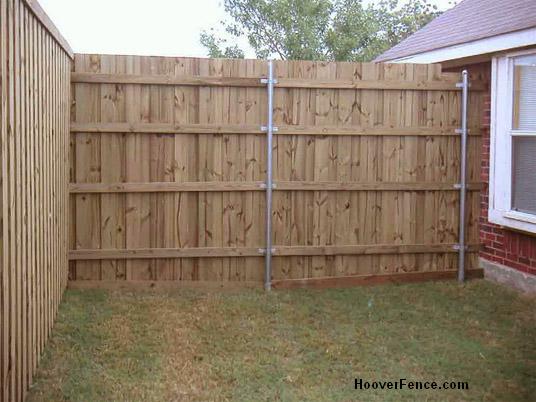 Applicable Products:
Wood Fence and Wood Fence Hardware
Applicable Products:
Wood Fence and Wood Fence Hardware
Reply: Thank you for your interest in our site and products. Brackets can be used successfully to mount a wood fence post to a concrete surface, however caution should be taken with thin concrete pads and privacy fences. Do not underestimate the strength and power that the windload can have on a fence. Naturally, the fence is only as strong as its weakest point, and if posts are not anchored sufficiently, problems will occur. I've often found neither the fence, post, or bracket failed, but rather the concrete by cracking and therefore causing fasteners which hold the bracket to the concrete surface become loose.
An in-ground fence post installation is most always the best, however not always an option. When concrete exists, it is often only a 4" or less pad and often not reinforced with wire, or rebar. Such thin pads crack easy, without heavy wind-bearing fences attached to them. Cutting a notch out of this thin pad and digging a conventional fence post footer is recommended for a taller privacy fence.
Wood fence panels installed on round galvanized posts. Special wood to steel fence post brackets are available in a variety of sizes and type to accomodate attaching wood fence rails to round posts.
Alternatively, drilling into the concrete and setting a round chain link style 2" or 2-1/2" O.D. galvanized post works well for supporting wood fence. We suggest using either an HF20 or HF40 grade post for this application. Since this post size is smaller than a conventional 4x4 wood post, it is easier to drill and can cause less stress on the concrete pad. An assortment of wood to steel fence post brackets are available as follows:
Economy Wood to Steel Fence Post Brackets I Mid-Range Wood to Steel Fence Post Brackets
Adjustable Wood to Steel Fence Post Brackets I OZ-POST Fence Post Brackets
Other fence post, deck post mounting brackets available in the industry consist of heavy halvanized steel formed, or welded to accept a 4x4 and other size posts. These are often quite strong and well made and usually all have large metal plates on the bottom predrilled for the insertion of concrete anchors.
Related Products:
Wood Fence and Accessories
Updated 06/19/09
Would you please suggest something for me? Is there a bracket you would recommend? Any info would be appreciated.
Applicable Products:
Wood Fence and Wood Fence Hardware
Reply: Thank you for your interest in our site and products. Brackets can be used successfully to mount a wood fence post to a concrete surface, however caution should be taken with thin concrete pads and privacy fences. Do not underestimate the strength and power that the windload can have on a fence. Naturally, the fence is only as strong as its weakest point, and if posts are not anchored sufficiently, problems will occur. I've often found neither the fence, post, or bracket failed, but rather the concrete by cracking and therefore causing fasteners which hold the bracket to the concrete surface become loose.
An in-ground fence post installation is most always the best, however not always an option. When concrete exists, it is often only a 4" or less pad and often not reinforced with wire, or rebar. Such thin pads crack easy, without heavy wind-bearing fences attached to them. Cutting a notch out of this thin pad and digging a conventional fence post footer is recommended for a taller privacy fence.
Wood fence panels installed on round galvanized posts. Special wood to steel fence post brackets are available in a variety of sizes and type to accomodate attaching wood fence rails to round posts.
Alternatively, drilling into the concrete and setting a round chain link style 2" or 2-1/2" O.D. galvanized post works well for supporting wood fence. We suggest using either an HF20 or HF40 grade post for this application. Since this post size is smaller than a conventional 4x4 wood post, it is easier to drill and can cause less stress on the concrete pad. An assortment of wood to steel fence post brackets are available as follows:
Economy Wood to Steel Fence Post Brackets I Mid-Range Wood to Steel Fence Post Brackets
Adjustable Wood to Steel Fence Post Brackets I OZ-POST Fence Post Brackets
Other fence post, deck post mounting brackets available in the industry consist of heavy halvanized steel formed, or welded to accept a 4x4 and other size posts. These are often quite strong and well made and usually all have large metal plates on the bottom predrilled for the insertion of concrete anchors.
Related Products:
Wood Fence and Accessories
Updated 06/19/09
Should gravel be used under or around cedar fence posts?
Question:
We have heavy clay soils - should I mix in some #57 with the native soil during fence post backfill, use #57 for most of it, or just use and tamp the native soil (no rock)? I have read where it is recommended to at least put a few inches of rock in the bottom of the fence post hole, but then varying opinions of whether or not to use rock in the backfill mix. Should gravel be used for fence posts, specifically western red cedar split rail posts?
Applicable Products:
Wood Fence/ Split Rail Fence
Reply: Thank you for your interest in our site and products. Most professional fence installers/ contractors do not use gravel when backfilling and tamping western red cedar posts (split rail fences and traditional picket fences) in place. I believe this is typically due to it not being readily available on the job site. For those wanting a better installation, we do recommend gravel at least under the post as this will allow a place for water to drain to, away from your post which causes them to rot prematurely. Some soil compositions are not fence post friendly, or are extremely wet. We have often needed to truck in gravel to tamp under, and around fence posts. Gravel can serve two purposes, drainage and stability.
Related Products:
Wood Fence and Accessories:
Western Red Cedar Split Rail
Fence Post Tamping Tools:
Digger Tamper Bar, Forged Steel, 6' Long, Chisel Point
Structron 8" Tamper
Updated 10/16/09
Reply: Thank you for your interest in our site and products. Most professional fence installers/ contractors do not use gravel when backfilling and tamping western red cedar posts (split rail fences and traditional picket fences) in place. I believe this is typically due to it not being readily available on the job site. For those wanting a better installation, we do recommend gravel at least under the post as this will allow a place for water to drain to, away from your post which causes them to rot prematurely. Some soil compositions are not fence post friendly, or are extremely wet. We have often needed to truck in gravel to tamp under, and around fence posts. Gravel can serve two purposes, drainage and stability.
Related Products:
Wood Fence and Accessories:
Western Red Cedar Split Rail
Fence Post Tamping Tools:
Digger Tamper Bar, Forged Steel, 6' Long, Chisel Point
Structron 8" Tamper
Updated 10/16/09
Should end posts or corner posts be set first when installing western red cedar split rail fence?
Question:
Should corner and end posts for a cedar split rail fence be set first? I have a gently rolling backyard, and I see that the fence cedar rails butt inside the fence posts rather than overlap. After I mark my corner post locations and run my line, is it easier to install the posts as we go, and not set the corner post until we get to the corner, hopefully preventing any long/short distance issues? Most everything I have read says to set the corner posts first, but I really see no need to do that if you stake the locations and run the line. Especially if you have some slope in the fence run, as that will alter shorten the final horizontal length.
Applicable Products:
Wood Fence/ Split Rail Fence
Reply:
Western Red Cedar Split Rail
Fence Post Tamping Tools:
Digger Tamper Bar, Forged Steel, 6' Long, Chisel Point
Structron 8" Tamper
Updated 10/16/09
Reply:
Standard Procedure for Installing Split Rail Fences:
Some 'how to build fence' books available do not give accurate, or practical information on building fences. Having professionally built fences for over 15 years, working for a fence business which has been in business over 30 years allows me some credibility with this statement. Many 'How-To-Build Fence' books recommend setting corner posts first. They most likely do this simply to define the starting, turning, and stopping point of a fence. Most professional fence contractors will start the fence installation and simply work their way around using guide string to the finish point. We recommend this procedure with split rail, or any fixed width fence style. Dig the fence post holes using a guide string, set fence post in empty hole, attach section fence (rails) and tamp last. You should easily be able to drill 5-6 holes at a time, set posts, assemble fence, and tamp last. If you try to drill much more than this, or a whole fence line of many more holes, you risk losing your proper fence post spacing. Plus, you will occasionally meet challenges while drilling such as roots or rocks which may force you to move a post slightly or even shorten rails to dodge such obstacles. We've found installing a number of sections at a time and doing so completely to be the best practice. Also, with this procedure - what you see is what you get so there is very little chance to error.Related Products:
Wood Fence and AccessoriesWestern Red Cedar Split Rail
Fence Post Tamping Tools:
Digger Tamper Bar, Forged Steel, 6' Long, Chisel Point
Structron 8" Tamper
Updated 10/16/09